Why Spray Foam Rodent Exclusion Fails — Anna, TX
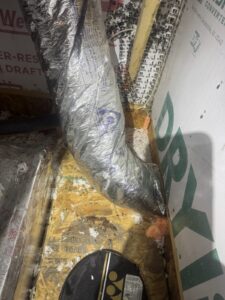
At the time of the inspection, identified roof rat activity in the attic. The homeowner had a roofline area where rodents were getting into…
Proudly Serving Anna and Surrounding Communities
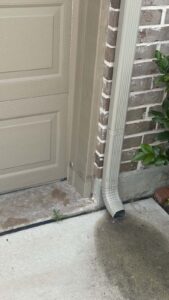
The customer had rats getting into the garage through the corner where the garage door jam is generally cut at a 45° angle.
Upon the inspection, it was determined that the concrete was slightly sloped in addition to the gap at the garage door corner that was allowing rodents to get inside.
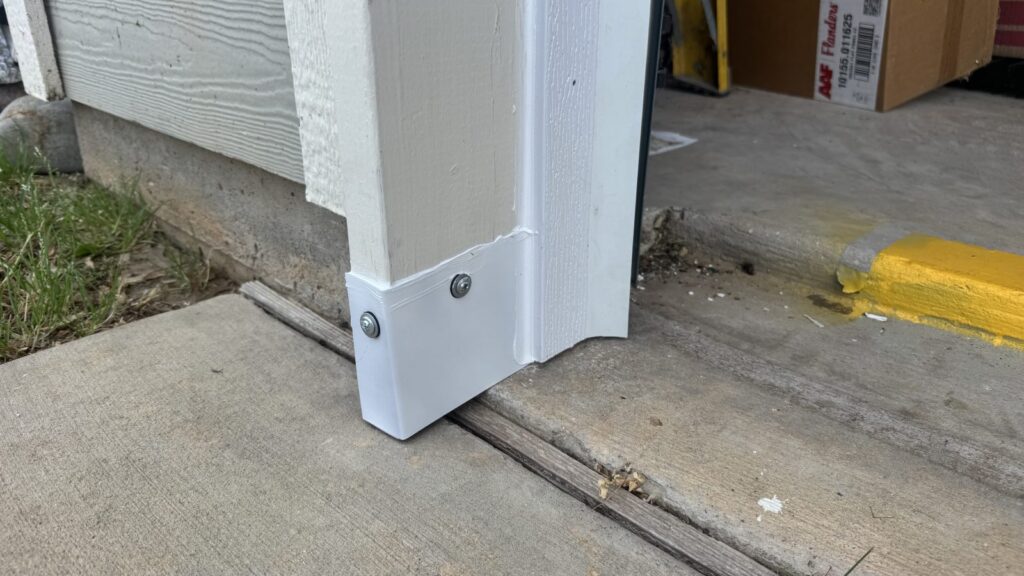
Using sheet metal to seal, this corner was the best way to prevent rodents from getting into the garage. We had to get a little bit creative because of the slope of the driveway.
Rats were getting into this garage through the garage door corner. Crouch at the bottom of almost any garage door jamb and you will find the trim cut back at roughly 45 degrees.
Builders do that deliberately. The angle lets the door track sit properly, and it sheds water away from the frame instead of into it.
Unfortunately the cut also leaves a small triangular void at each bottom corner, between the jamb, the slab and the door. A rat needs about half an inch. That void is frequently larger.
Most people assume the rubber strip along the bottom of the door handles this. That seal squashes flat against a level slab, across the width of the opening, and it works in a straight line.
The gap at a garage door corner sits outside that line. You will find it behind and beside the seal, where the vertical jamb meets the floor.
So a door can shut perfectly, look sealed, and still leave two openings. Homeowners check the door, see it sitting flush, and rule it out.
This driveway sloped slightly, which is entirely normal. Builders pour a slab with a fall so that water runs away from the building rather than under it.
However, a door built straight then meets a floor that is not. The seal touches at the high point and lifts away at the low one, so the corner gap widens on the downhill side. That was the side the rats used.
An off-the-shelf part often fails here for exactly that reason. The fix has to match the slope the driveway actually has.
Treating a garage as outside feels reasonable. Rodents disagree.
Most garages have a door into the house, shared wall cavities, and often an attic hatch or a roof void overhead. Water heaters, softeners and HVAC lines all pass through the wall. Every one of those is a route inward.
A garage also offers what rodents want: stored food, pet food, cardboard, insulation and quiet. Once something settles in, getting it back out of an attic becomes a far longer job. Texas A&M AgriLife Extension describes how rodents move through a structure once they are inside.
We closed both corners with formed sheet metal, shaped to the actual gap and fixed to the jamb.
Metal matters. Rodents chew foam, and they chew most plastics. They do not chew steel, and a corner is precisely where something will keep trying.
Because of the slope, we shaped each piece on site rather than fitting it square. That is the usual reality of this repair, since every driveway falls a little differently.
Want to check your own? Shut the door, crouch at each bottom corner, and look for daylight. That is the fastest rodent inspection there is, and we can close the gap if you find one.
Real jobs from our own records — what the inspection found, and why we treated it the way we did.
At the time of the inspection, identified roof rat activity in the attic. The homeowner had a roofline area where rodents were getting into…
There was a large gap at the corner of the garage door that rodents were entering the garage through.
Holes in the soffits form rodents chewing through

More on this: Rodent Control in Denison